Manuel Antonio National Park sits at the intersection of two distinct ecosystems — Pacific coastal forest and lowland tropical rainforest — which is why the wildlife density here is extraordinary. In a single morning walk, you might spot three species of monkey, a sloth, a Jesus Christ lizard running across water, and a scarlet macaw overhead. Here's what to look for and how to find it.
Mammals
🦥 Three-Toed Sloth
The undisputed star of Manuel Antonio. Three-toed sloths are active during the day (unlike their two-toed cousins who are mostly nocturnal) and are relatively common in the park. They spend 15–20 hours a day motionless in the canopy, which makes them surprisingly hard to spot without a guide and spotting scope — they look exactly like a ball of moss or a knot in a branch.
Where to find them: Look for cecropia trees (large-leafed, distinctive trunk markings) — sloths love to feed on these. The guides know the specific trees along the main trail where sloths are reliably spotted.
Best time: Morning, when they've moved to sunny branches to warm up after the cool night.
🐒 White-Faced Capuchin Monkey
The most commonly seen primate in the park and also the boldest — capuchins are highly intelligent, curious, and completely habituated to humans. They'll come very close. Don't feed them (it's harmful to their diet and teaches bad behavior) but do enjoy watching them figure out how to open things and communicate with each other. Fascinating animals.
🐒 Squirrel Monkey
Manuel Antonio is one of the last remaining habitats of the Central American squirrel monkey — one of the most endangered primates in Costa Rica. Smaller and shyer than the capuchins, they travel in large troops through the canopy. Your guide will know the current troop locations and how to position you for the best viewing.
🐒 Mantled Howler Monkey
You'll hear them before you see them — the howler's call is one of the loudest sounds in the animal kingdom, a deep roar that carries for miles through the jungle. They tend to stay high in the canopy and move slowly. Early morning is when they're most vocal.
Birds
🦜 Scarlet Macaw
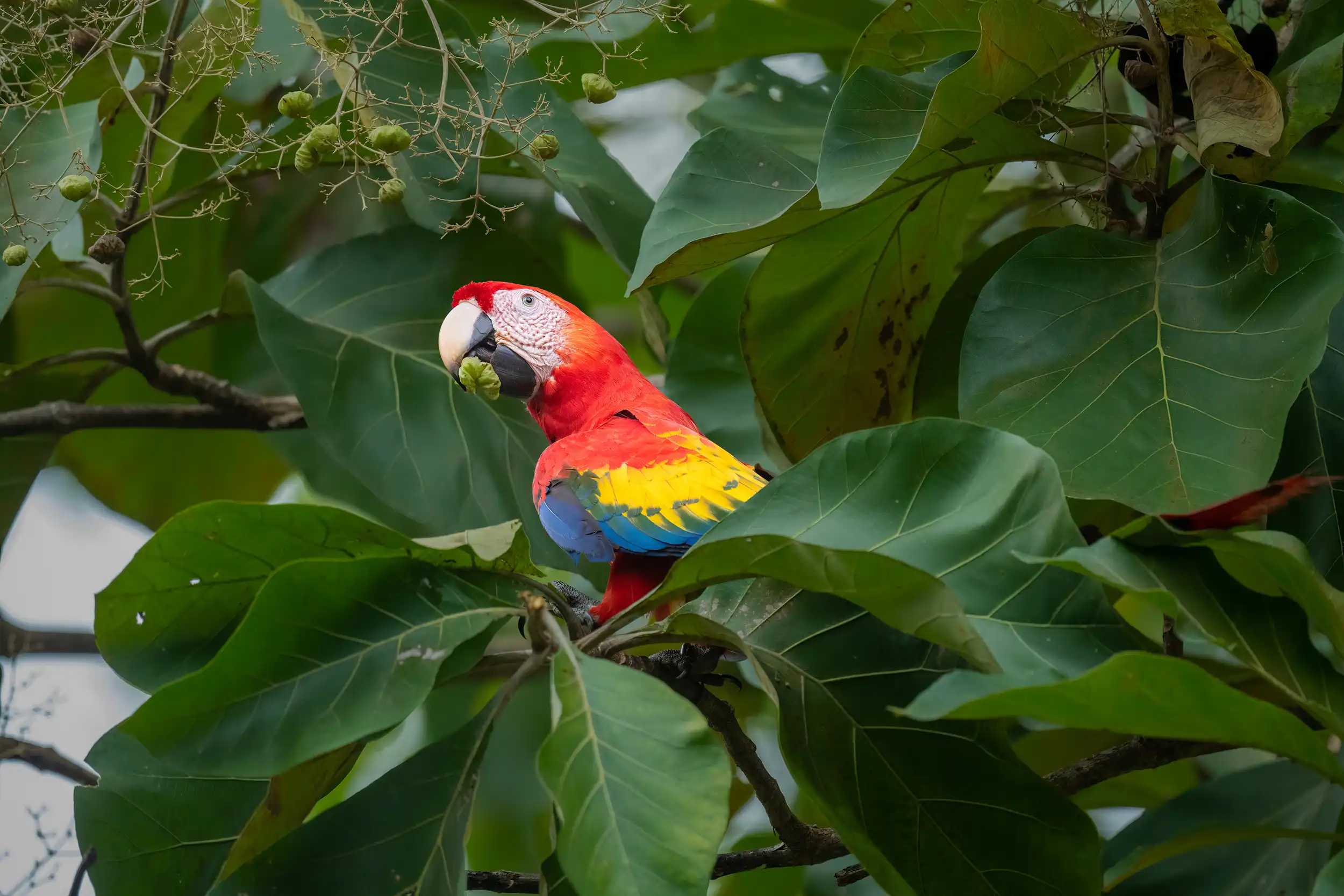
One of the most visually stunning birds on the planet — a shock of red, yellow, and blue against the green canopy. They mate for life and are often spotted in pairs. Manuel Antonio has a healthy resident population. Listen for their loud, raucous calls and look at the tops of the tallest trees along the coast.
🦅 Magnificent Frigatebird
Huge, prehistoric-looking seabirds that soar effortlessly on thermals over the coast. The males have an extraordinary red throat pouch they inflate during mating season. Easy to spot from the beaches inside the park.
🐦 Toucans & Motmots
Both are common in the park and both are spectacular. The blue-crowned motmot has distinctive racket-tipped tail feathers that it swings like a pendulum. Chestnut-mandibled toucans travel in noisy groups through the canopy. Your guide's spotting scope makes all the difference for seeing plumage detail.
Reptiles & Amphibians
🦎 Jesus Christ Lizard (Basilisk)
Named for their ability to run across the surface of water on their hind legs — a sight that genuinely stops people in their tracks. Common along any stream or pool in the park. Brilliant green, fast, and completely unafraid of humans.
🐊 American Crocodile
The Río Naranjo estuary near the park entrance is home to resident crocodiles. They're large, calm, and easy to photograph from a safe distance on the road bridge. Your guide will know if they're visible that morning.
🐢 Sea Turtle
Olive ridley sea turtles are the most common nesting species in the region, with nesting season running July through November. They're also spotted year-round while snorkeling in the protected coves around the park — one of the highlights of the ocean kayaking tour.
Marine Life
The protected coves around Manuel Antonio have healthy coral reefs. Common snorkeling sightings include parrotfish, sergeant majors, angelfish, moray eels, sea urchins, rays, and occasional sea turtles. Dolphins are frequently spotted offshore, especially on calmer morning seas.
| Species | Best Time | Where | Difficulty to Spot |
|---|---|---|---|
| Three-toed Sloth | Morning | Cecropia trees, main trail | Hard without guide |
| Capuchin Monkey | All day | Throughout park | Easy |
| Squirrel Monkey | Morning | Secondary forest edges | Medium |
| Scarlet Macaw | Early morning | Coastal treetops | Medium |
| Jesus Christ Lizard | All day | Near streams & pools | Easy |
| Sea Turtle | Snorkeling / nesting season | Protected coves | Seasonal |
The Golden Rule: Go With a Guide
We say this not to sell tours but because it's genuinely true. The difference between a self-guided park walk and a guided tour is the difference between spotting 2–3 animals and spotting 15–20. Our naturalist guides have been walking these trails for 10–15 years. They know which trees the sloths use this week, where the squirrel monkey troop is currently ranging, and how to position you so the morning light hits the macaw just right for photos.
The spotting scope alone transforms the experience — bringing a sloth in the canopy to arm's-length detail, revealing the individual feathers on a toucan's beak, showing you the gecko on the branch you would have walked right past.
🌿 Book a Guided National Park Tour — hotel pickup, certified bilingual naturalist guide, spotting scope, and 5 hours in one of the world's most biodiverse places.
Book the Tour